

Rummy Modern: Rules, Formats and Beginner’s Guide

Rummy Modern is not one single, universally recognised game. Several unrelated mobile products use similar names, and the phrase is also used loosely for present-day versions of Indian rummy. That matters because the rules you learn from a general guide may not match the rules inside a particular app, and because the legal position of online card games in India changed in 2026.
Rummy Modern refers to mobile card games and adaptations of traditional rummy, although different apps may use the name. In standard Indian 13-card rummy, players draw and discard cards to form valid sequences and sets, including at least one pure sequence. Beginners should learn the rules through free, non-money games and check each version’s specific format.
Notice for readers: this article is for adults aged 18+ only. Gambling can be addictive and can cause serious financial loss. Nothing here encourages playing for money.
What Is Rummy Modern?
The short answer: Rummy Modern is an ambiguous search term, not a single verified ruleset or a single verified application. People type it when they want a particular app, and others type it when they simply want to understand how rummy works on a phone today.
Rummy Modern as an App Name
Search results for this phrase mix very different things. One result describes an older Android package listing. Another is an explanation page that focuses on Android setup. A third is a separate listing for an offline card game under a similar name. These pages do not prove that one developer, one product or one set of rules stands behind the name, and I am not treating them as such. Two apps with near-identical titles can be unrelated, and a similar name proves neither common ownership nor authenticity.
Because of this, I do not recommend any app here, and I do not give download or installation guidance. An app listing only records what its publisher chooses to claim. It does not independently confirm which rules the game follows, whether it is fair, or whether it is lawful in your state.
How It Relates to Indian Rummy
Indian Rummy is a family of related card games, and the best-known member is 13-card rummy, where each player holds 13 cards and tries to arrange them into valid groups. Those conventional rules are a useful reference point for beginners. They are not an automatically verified feature list for every app that carries a similar name. A version may change the number of decks, the joker rules, the scoring or the penalty for a wrong declaration.
This guide therefore does two jobs. It explains the familiar rules so that you can read any rules page critically, and it separates what is conventional from what must be checked in each version. The aim is understanding terminology, rules and formats before you choose a safe place to practise.
Basic Rummy Modern Rules Explained
The rules below describe conventional 13-card Indian rummy. They are a reference ruleset, and any specific version may differ.
The Objective and Card Setup
The objective is to arrange all 13 cards in your hand into valid groups and then make a valid declaration before the other players do. Usually 2 to 6 players take part, and each receives 13 cards. Two standard 52-card decks, often with printed jokers added, are common, although the actual number of decks varies by version. Cards rank from Ace through King, with Ace usable low (A-2-3) and, in most rulesets, high (Q-K-A).
After dealing, the remaining cards form a face-down closed pile (also called the stock). One card is turned face up beside it to start the open discard pile. A random card may also be turned up to decide the wild joker, meaning every card of that rank acts as a substitute. A printed joker is the joker card that comes in the deck itself.
How Drawing and Discarding Work
On each turn, a player draws exactly one card, either the top card of the closed pile or the top card of the open pile. The player then discards exactly one card face up onto the open pile, which ends the turn. The hand therefore returns to 13 cards after every turn.
Here is one ordinary turn, using cards only:
- You hold 13 cards, including 9♥, 10♥ and Q♥, and you notice that J♥ would join them in a run.
- You check the top of the open pile, which shows 2♣. You do not need it, so you choose the closed pile instead.
- You draw J♥. Your hand now has 14 cards.
- You arrange 9♥ 10♥ J♥ Q♥ together as a four-card pure sequence.
- You discard 2♣, which belongs to no group, onto the open pile. Your hand is back to 13 cards and the turn passes.
When You Can Declare
A valid declaration normally requires at least two sequences, one of which is a pure sequence, with all remaining cards placed in valid sequences or sets. All 13 cards must be accounted for. In most rulesets you declare by discarding your last card in a designated finish slot, and the other players then submit their own hands for scoring. Declaring too early, with a group that is not valid, usually carries a penalty, which is covered in the scoring section.
Pure Sequences, Impure Sequences and Sets
A pure sequence is a run of at least three consecutive cards of the same suit with no joker standing in for a missing card. An impure sequence is a run of at least three consecutive cards of the same suit in which a joker replaces one or more cards. A set is three or four cards of the same rank, each from a different suit. Together, sequences and sets are called melds.
| Group | What it contains | Joker allowed? | Example |
|---|---|---|---|
| Pure sequence | 3 or more consecutive cards of one suit | No substitute use; a wild joker may count only as its natural card in some rules | 3♠ 4♠ 5♠ |
| Impure sequence | 3 or more consecutive cards of one suit, with at least one joker as a substitute | Yes | 9♥ 10♥ Joker Q♥ (Joker as J♥) |
| Set | 3 or 4 cards of the same rank, all different suits | Yes, as a substitute | K♣ K♦ K♥ |
Jokers come in two kinds. A printed joker always acts as a substitute. A wild joker, chosen by a turned-up card, can also be used as its natural card when it sits in its own rank and suit. Whether a natural wild joker is allowed inside a pure sequence depends on the ruleset, so check it before relying on it.
Ace-high and Ace-low are the other common variation. Most rulesets accept A-2-3 and Q-K-A, but many reject a wrap-around run such as K-A-2.
A Valid 13-Card Hand
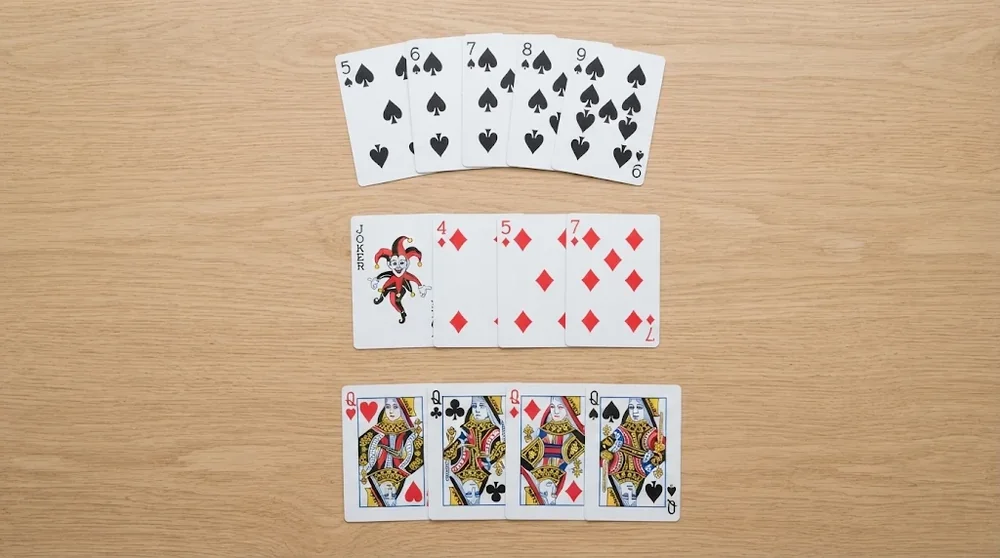
This hand is valid under the conventional rules described above:
- 3♠ 4♠ 5♠ is a pure sequence (3 cards).
- 9♥ 10♥ Joker Q♥ is an impure sequence, with the Joker standing for J♥ (4 cards).
- K♣ K♦ K♥ is a set (3 cards).
- 6♦ 7♦ 8♦ is a second pure sequence (3 cards).
The count is 3 + 4 + 3 + 3 = 13 cards. The hand has two sequences, at least one of them pure, and every card sits in a valid group.
An Invalid 13-Card Hand
Now consider this hand: 5♠ 6♠ 7♠; A♦ 2♦ 3♦; Q♣ Q♦ Q♥; 9♥ 10♥ J♦; and K♠. It also totals 13 cards, but it fails. The group 9♥ 10♥ J♦ mixes hearts and diamonds, so it is not a sequence. The K♠ belongs to no group at all. The pure sequences are fine, yet a declaration needs every card placed.
A second common failure is a hand with no pure sequence, where jokers fill every run. Even if all 13 cards seem grouped, the declaration is normally invalid. Rule details such as Ace order and natural wild jokers are variant rules, so a hand valid in one version may be rejected in another.
Rummy Modern Formats: Points, Pool and Deals
Points, Pool and Deals are familiar general formats of Indian rummy. They are not confirmed modes of any named application, and an app may offer one, several or none of them. The table below describes only the typical structure of each, without any monetary element.
| Format | How It Works | Typical Duration Structure | Beginner Considerations | Rule Variations to Check |
|---|---|---|---|---|
| Points Rummy | Each deal is settled on its own using the points left in losing hands | Usually a single deal | Short and easy to follow; good for repeating the basics | Drop penalties, wrong-declaration penalty, joker rules |
| Pool Rummy | Penalty points add up over several deals; players leave once they pass a limit | Several deals until one player remains | Longer sessions; needs attention to a running total | Limit of 101 or 201, drop values, re-entry rules |
| Deals Rummy | A fixed number of deals is played and results are totalled | Set in advance, often two to six deals | Predictable length; scorekeeping matters | Number of deals, tie handling, score or chip accounting |
Points Rummy
Points Rummy generally resolves one deal at a time. The first player to make a valid declaration ends the deal, and the other players are scored on the cards left unmatched in their hands. Because each deal stands alone, it is the simplest format for learning melds.
Pool Rummy
Pool Rummy accumulates penalty points over multiple deals. A player who passes a set threshold, commonly 101 or 201, is eliminated, and the last player under the limit finishes ahead. Thresholds and re-entry rules differ, so they must be read from the rules of the version in use.
Deals Rummy
Deals Rummy runs for a fixed number of deals agreed beforehand. Scores are totalled across those deals. The word chips sometimes appears as a scoring unit in this format, and in a card-learning setting chips are only counters; they do not have to mean money.
Other Rummy Variations
21-card rummy uses three decks and hands of 21 cards, and it usually requires more sequences for a valid declaration. Gin Rummy is a different two-player game with 10-card hands, where players form melds and knock instead of declaring. These are separate games from standard 13-card rummy, and nothing here suggests that any particular product includes them.
How to Learn Rummy Modern Step by Step
The safest way to learn the rules is to use ordinary playing cards at home, or a rules worksheet, rather than any app. No account, deposit or installation is needed for this. Learning the rules is also a different activity from taking part in an online service. This exercise is about the first only.
- Identify the precise ruleset. Write down the number of players, the number of decks, whether printed jokers are used and whether a wild joker is chosen. Decide on Ace-low and Ace-high rules before you begin.
- Sort the cards. Deal yourself 13 cards and arrange them by suit, then by rank. Sorting makes runs and sets visible at a glance.
- Form a pure sequence. Look for three consecutive cards of one suit with no joker, such as 4♣ 5♣ 6♣. Secure this group first, since it is mandatory for a valid declaration.
- Work towards the second sequence and other melds. Build a second sequence, then use the remaining cards for sets or impure sequences. Note which cards belong to no group.
- Practise the draw-discard cycle. Place the rest of the deck face down, turn one card up as the open pile, and practise drawing one card and discarding one. Your hand should always return to 13 cards.
- Verify all 13 cards before declaring. Count each group aloud, confirm each suit, and confirm that at least one pure sequence and a second sequence exist. Only then treat the hand as a valid declaration.
A Simple Practice Hand
Try this arrangement with real cards: 3♠ 4♠ 5♠, 6♦ 7♦ 8♦, K♣ K♦ K♥, and four cards (9♥ 10♥ Joker Q♥). Then mix the cards and rebuild the same groups from scratch without looking at the answer.
Practice Checklist
- Is the ruleset written down before the practice session starts?
- Does the hand have exactly 13 cards after every discard?
- Is there at least one pure sequence made of one suit with no joker?
- Does every card belong to a group, with no leftover card?
- Were Ace order and joker rules checked against the chosen ruleset?
Rummy Scoring and Common Beginner Mistakes
How Card Points Are Counted
In conventional rummy scoring, numbered cards from 2 to 9 carry their face value. Aces, Kings, Queens, Jacks and 10s are commonly worth 10 points each. A designated joker, whether printed or wild, normally counts as zero when it is scored as a joker. A player who declares validly scores zero for the deal, and other players count the cards they could not place in valid groups.
A worked example, with no money involved: suppose a player’s only unmatched cards are K♠ and 4♦. Under a ruleset that counts only unmatched cards, the penalty is 10 + 4 = 14 points. Rule guides disagree on one point here. If a hand has a pure sequence but no second sequence, some rulesets count every card outside the pure sequence, while others count only the cards that sit in no valid group. Check which approach the ruleset uses.
Wrong Declarations and Dropping
Dropping means leaving a deal early. Common conventions are 20 penalty points for a first drop (before taking a first card) and 40 points for a middle drop (after taking at least one card), with 80 points often used as a maximum penalty for a wrong declaration or a full hand count. These figures are examples that vary by format and version, and they are not universal rules.
My assessment, clearly labelled as opinion: scoring and penalties are where beginners are most often caught out, because they assume the numbers they read once apply everywhere. I would read the penalty rules of any ruleset before looking at anything else.
Five Mistakes Beginners Can Avoid
- Declaring too early. A declaration made before all 13 cards sit in valid groups can attract the maximum penalty.
- Confusing suits. A run such as 9♥ 10♥ J♦ looks complete, but mixed suits make it invalid.
- Relying on jokers for the required pure sequence. A joker-based run never satisfies the pure-sequence requirement.
- Overlooking Ace order. Q-K-A is usually accepted, while K-A-2 usually is not; the ruleset decides.
- Assuming every version uses the same rules. Deck count, joker handling and penalties differ, so read them first.
These points help you manage a hand and understand penalties. They do not promise any result, and they are not a method for gaining money.
Is Rummy Modern Legal in India?
The short answer: legality depends on what the activity actually is, not on the game’s name. As of November 2026, India’s national framework prohibits online money games. This is a general overview and not legal advice.
National Online Gaming Rules as of November 2026
The Promotion and Regulation of Online Gaming Act, 2025 was enacted by Parliament in August 2025. The Ministry of Electronics and Information Technology notified the Promotion and Regulation of Online Gaming Rules, 2026 on 22 April 2026. According to official Government of India publications, the framework became operative on 1 May 2026. The Rules set up the Online Gaming Authority of India as an attached office of the ministry, with a process for deciding how a game is classified.
The Act prohibits online money games, and published legal commentary notes that this covers games of skill, games of chance and games combining both. Earlier court discussions about rummy being a game of skill therefore do not automatically exempt an online real-money rummy service under the newer national law. The Act also separates online social games and e-sports for different, lighter regulatory treatment.
Free Social Games Versus Online Money Games
An ordinary offline card game played with physical cards at home is a different matter from an online service. The national framework concerns online games. As the Rules are described in published commentary, the question is whether money or other stakes are involved at any stage, and not only how the game describes itself. The classification of a particular app cannot be established from its title or promotional description. A product called Rummy Modern might be a free social game, or it might involve payments or monetary benefits, and I cannot tell which from a name.
State laws also exist, and some states have their own gambling rules or licensing arrangements for physical venues. I am not asserting any exception for Goa, Sikkim, Daman, Mumbai or Delhi under the national online framework, and readers should not assume one. Rules can change after November 2026. Check current law, official government announcements and the relevant state rules, and consult a qualified Indian lawyer for any individual legal question. Check the law of your state before you play anywhere. I give no guidance on getting around any restriction.
How to Check a Rummy App Safely
The risk you should know about first: an app that looks like a harmless card game can still collect data, push payments or promise monetary rewards. An app-store listing does not establish legal compliance, fairness or independent verification. Use this checklist as a set of questions, not as a route to any particular app.
- Developer identity: Is a named developer shown with working contact details? A similar title does not mean the same developer.
- Version differences: Does the listing show a clear version and update history? Older packages may not match current rules or law.
- Privacy disclosures: Is there a readable privacy policy that explains what data is collected and why?
- Permissions: Does a card game ask for contacts, messages, location or storage access it does not obviously need?
- Age verification: Does the service state an 18+ requirement? A missing age check is a warning sign.
- Account protection: Never share OTPs, passwords or payment credentials with anyone, including people claiming to be support staff.
- Unexpected payment requests: A game advertised as free that asks for deposits, top-ups or card details needs a pause and a closer look.
- Advertising claims: Be wary of promises of guaranteed outcomes, rewards or special access.
- Unofficial APK files: Packages from outside a recognised store can carry malware or altered code, so I advise against them.
- Support information: Is there a working grievance or support route, and is the company address real?
- Signs of money solicitation: Wallets, cash-style prizes or purchasable chips are signs that a product may be an online money game under the 2026 framework.
Research Limits for This Article
What I checked, and what I could not check: I reviewed official Government of India material and published legal commentary on the 2025 Act and the 2026 Rules, along with the official description of Tele-MANAS. I did not independently install or test any application named Rummy Modern for this article, and I have no test records, screenshots or transaction logs to report. Public listings describe what a publisher claims and nothing more, so I do not treat them as proof of features, safety or lawful operation.

Responsible Rummy Play and When to Stop
Gambling can be addictive and can cause serious financial loss. This content is for adults aged 18+ only. The safest way to learn rummy is with physical cards or non-money games, where nothing is at stake.
Watch for warning signs in yourself or someone close to you:
- Chasing losses, meaning trying to recover money by playing more.
- Losing track of time, or sessions that keep getting longer than planned.
- Hiding play, spending or borrowing from family and friends.
- Feeling anxious, irritable or low when you are not playing.
If any of these sound familiar, stop and talk to someone you trust. Age checks, spending controls and legal restrictions are safeguards, and they are not barriers to get around. Never play with money you cannot afford to lose. That is a warning about risk, not encouragement to gamble.
Tele-MANAS is the Government of India’s free, 24-hour national tele-mental-health service, run under the Ministry of Health and Family Welfare. You can call 14416 (or 1-800-891-4416) and choose your language. It is a general mental-health counselling and support service and not a gambling-specific treatment programme, but a trained counsellor can listen and refer you onward. Details were confirmed against official health ministry material in November 2026.
Frequently Asked Questions About Rummy Modern
What is Rummy Modern and how do you play it?
Rummy Modern is a name used for mobile rummy games, but different applications may follow different rules. In conventional Indian 13-card rummy, each player arranges cards into sequences and sets by drawing and discarding. A valid declaration normally requires at least two sequences, including one pure sequence. Always check which ruleset a particular version uses.
What are the basic rules of Rummy Modern?
The familiar Indian 13-card rules require players to form valid combinations of cards. On each turn, a player normally draws one card and discards another. A winning declaration generally includes at least two sequences, one of them pure, with all remaining cards in valid sequences or sets. Joker rules, scoring and penalties may differ between versions.
How do you make a pure sequence in rummy?
A pure sequence normally contains at least three consecutive cards of the same suit without using a joker as a substitute. For example, 4♣, 5♣ and 6♣ form a pure sequence. A sequence containing cards from different suits is invalid. Some rules allow a designated wild joker to count naturally when it occupies its original rank and suit.
What is the difference between Points, Pool and Deals Rummy?
Points Rummy generally settles the result of each deal separately. Pool Rummy adds penalty points over multiple deals, often eliminating players at thresholds such as 101 or 201. Deals Rummy runs for a predetermined number of deals. These are common Indian rummy formats, but a specific app may not offer all three or use identical scoring rules.
Can you play Rummy Modern for free?
Some games described as Rummy Modern offer offline or non-money card play, although their features and identities must be verified individually. Beginners can also practise standard rummy rules using physical cards. Avoid assuming that a free download means there are no payments, data collection or gambling features. Check the rules, permissions and applicable law before using any digital game.
Is Rummy Modern legal in India?
Legality depends on the actual activity, not the game’s name. As of November 2026, India’s Promotion and Regulation of Online Gaming Act, 2025, and its 2026 Rules prohibit online money games while separately regulating online social games and e-sports. State-level rules may also matter. Check current official guidance and obtain qualified legal advice where needed.
Final Thoughts on Rummy Modern
Rummy Modern is best treated as a name to be checked, not a ruleset to be trusted. Learn the 13-card basics with ordinary cards, read the penalty and joker rules of any version before relying on them, and keep in mind that online money games have been prohibited under India’s national framework since 1 May 2026, as of November 2026. Law and rules can change, so check official sources and your state’s rules, speak to a qualified Indian lawyer about individual questions, and stop at once if play stops feeling like a game. This article is for adults aged 18+ only.